A Small Java Stream “Gotcha” That Cost Me More Time Than I’d Like to Admit
I ran into a subtle issue recently while working with Java Streams. It’s one of those problems that looks obvious after you know the answer—but can quietly waste a lot of time before that .
If you work with Streams and Lists, this one’s for you.
The Usual Way We Collect a Stream
When working with Java streams, we often end with a List. Most of the time, we do one of these:
List<String> names = stream.toList();
or
List<String> names = stream.collect(Collectors.toList());
I personally prefer toList() because it’s shorter, cleaner, and reads better. So naturally, I use it almost everywhere. Until… it broke my code.
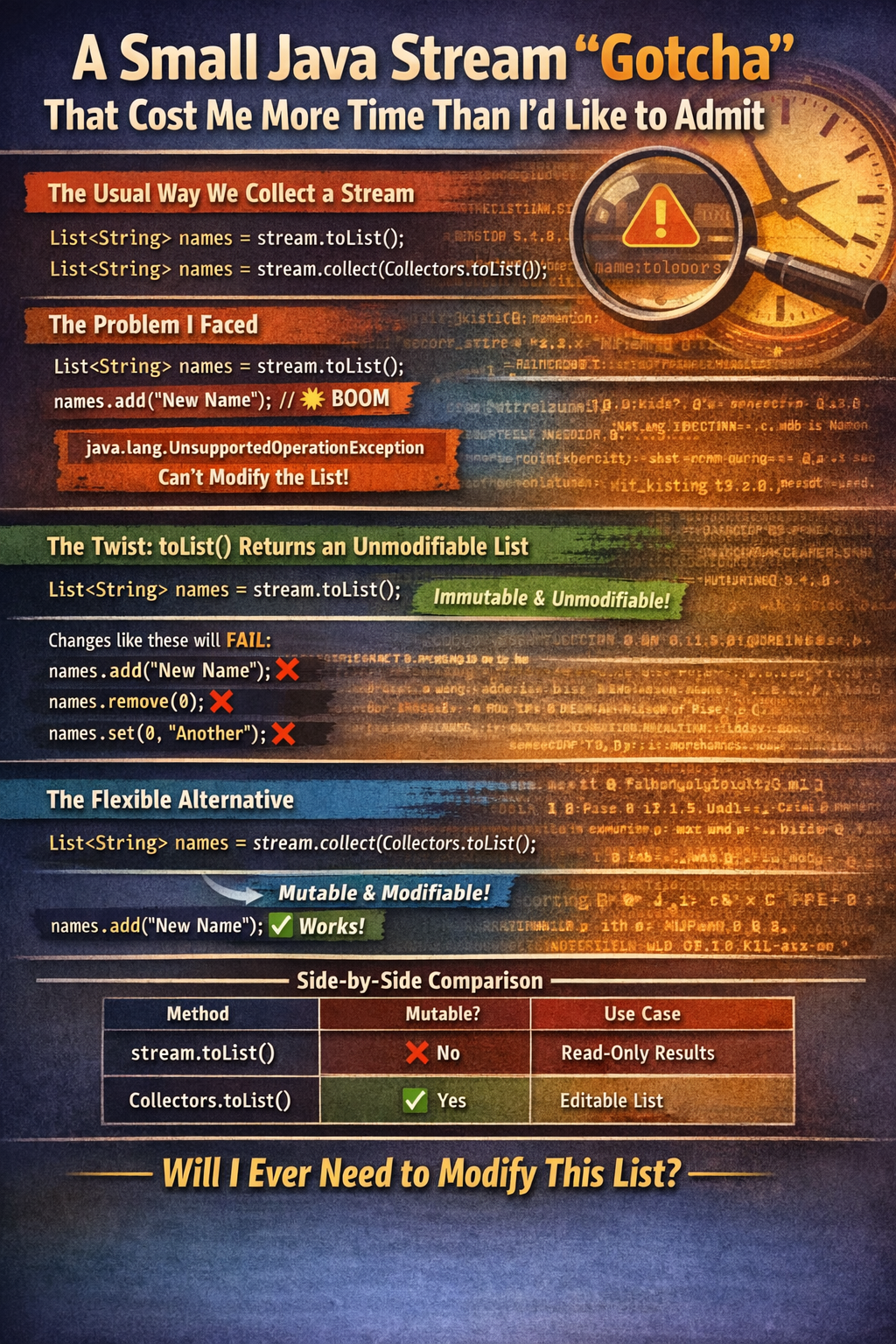
The Problem I Faced
I collected a list using toList() and later tried to modify it:
					List<String> names = stream.toList();
names.add("New Name"); // 💥 BOOM
And suddenly:
java.lang.UnsupportedOperationException
At first glance, this feels confusing. It’s a List, right? Why can’t I modify it?
The Twist: toList() Returns an Unmodifiable List
Here’s the key detail many of us miss: Stream.toList() returns an unmodifiable (immutable) list. This behavior was introduced intentionally in Java 16. So, while this works:
					List<String> names = stream.toList();
System.out.println(names);
These will all fail at runtime:
- names.add(“New Name”); ❌
- names.remove(0); ❌
- names.set(0, “Another”); ❌
The Alternative: Collectors.toList() Gives You Flexibility
If you need to modify the list later, you must use the older approach:
					List<String> names = stream.collect(Collectors.toList());
names.add("New Name"); // ✅ Works
This returns a mutable list (usually an ArrayList), allowing you to add, remove, or update values without surprises.
Side-by-Side Comparison
Method | Mutable? | Use Case |
stream.toList() | ❌ No | Safe, read-only results (Java 16+) |
stream.collect(Collectors.toList()) | ✅ Yes | When you need to modify the list later |
When Should You Use Which?
Use toList() when:
- You want immutability for safer code.
- The list is a final result.
- You want cleaner, modern syntax.
Use Collectors.toList() when:
- You plan to add() or remove() elements later.
- You are building or transforming data step-by-step.
Final Thoughts
This isn’t a bug—it’s a design decision. Java is nudging us toward immutability by default, which leads to fewer side effects and safer code.
But as developers, we still need to choose the right tool. Now, whenever I reach for toList(), I pause and ask: “Will I ever need to modify this?” That one question saves a lot of debugging time.