The internet has changed a lot over the years and so has the way browsers communicate with servers. One of the main reasons some websites feel so fast while others seem to drag is the version of HTTP (HyperText Transfer Protocol) they use. Let’s dive into how HTTP/1.1 and HTTP/2 operate, what sets them apart and why HTTP/2 can significantly boost your browsing speed and efficiency
What is HTTP?
HTTP stands for HyperText Transfer Protocol and it’s the backbone of the web. Every time you enter a website address, your browser sends an HTTP request to the server hosting that site, which then responds with the content you’re looking for. This content can be anything from text and images to videos, files or scripts.
HTTP/1.1: The Old Workhorse
Launched in 1999, HTTP/1.1 was a major advancement over the previous version (Http/1) but it still has some limitations that can impact performance today.
Key features of HTTP/1.1:
- Usually one request per connection, which slows things down.
- Pipelining allowed multiple requests but it wasn’t reliable.
- Text based headers, which made communication bulkier.
- Each image, CSS or JS file typically needed its own separate TCP connection.
Example: Loading a webpage with HTTP/1.1
Imagine visiting an e-commerce site:
- Browser requests index.html → Server responds.
- Browser requests style.css → Server responds.
- Browser requests images (logo.png, banner.jpg) and scripts (app.js) → Each gets its own response.
If the page has over 50 resources, the browser has to manage multiple connections, often waiting for one to finish before starting another. This creates bottlenecks, resulting in longer page load times.
HTTP/2: A Smarter, Faster Upgrade
Introduced in 2015, HTTP/2 redefined how browsers and servers interact, with a strong emphasis on speed and efficiency.
Major improvements include:
Multiplexing→ Multiple requests and responses can share a single connection at the same time.
- Binary protocol → Faster and lighter than text-based headers.
- Header compression → Reduces unnecessary data transfer.
- Server push → Servers can send files before the browser even asks for them
Example: Loading the same e-commerce site with HTTP/2
- Browser requests index.html.
- The server sends back HTML, plus all images, scripts, and CSS files simultaneously all over one connection.
Analogy:
- HTTP/1.1 is like mailing 10 letters separately and waiting for each to arrive.
- HTTP/2 is like sending those 10 letters in one package, delivered together and much faster.
Multiplexing vs Multiple TCP Connections
Multiple TCP Connections (HTTP/1.1)
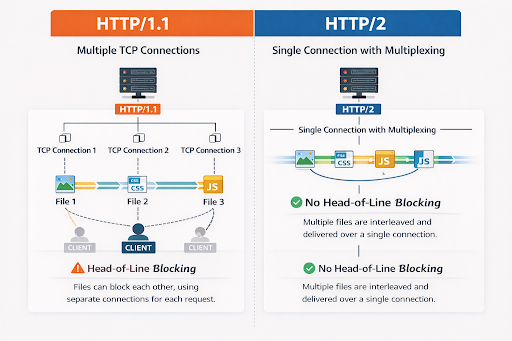
HTTP/1.1 handles concurrency by opening several TCP connections between the client and the server. Each connection is responsible for delivering one request response pair at a time.
So when a webpage needs an image, a CSS file and a JavaScript file the browser doesn’t wait for one to finish before starting the next. Instead, it opens multiple connections and downloads files in parallel.
While this works, it comes with trade offs:
- Each TCP connection has its own handshake and overhead
- Browsers limit the number of connections per domain
- Requests on the same connection are processed sequentially
- A slow response can block others (head-of-line blocking)
In short, HTTP/1.1 achieves parallelism by brute force more connections, more overhead.
Multiplexing (HTTP/2)
HTTP/2 takes a more intelligent approach. Instead of opening a bunch of TCP connections, it uses a single connection and divides it into multiple independent streams. Each stream carries a part of a request or response and all streams can move at the same time over that one connection
This means:
- Files are broken into smaller chunks
- Chunks from different files are interleaved
- A slow file does not block faster ones
- No need to open extra TCP connections
This technique is called multiplexing and it allows HTTP/2 to deliver multiple files concurrently and efficiently avoiding the connection overload seen in HTTP/1.1.
gRPC: The Modern API Protocol
Built on HTTP/2, gRPC is designed not just for websites but for modern applications, APIs and microservices.
Key advantages:
- Protocol Buffers (Protobuf): Compact binary format, faster than JSON.
- Streaming: Bi-directional communication between client and server.
- Cross-platform: Supports multiple programming languages.
- Strict contracts: Ensures consistency using
Compression: Speed in Action
Both protocols offer compression but HTTP/2 takes the lead with its binary format. By minimizing headers and cutting down on overhead, HTTP/2 conserves bandwidth, which is a huge plus for mobile networks where speed and data usage are crucial.
Common algorithms: gzip, deflate and more recently Brotli (br).
However, in HTTP/1.1 headers aren’t compressed, meaning every request still sends bulky, repetitive headers like cookies and user agents.
Why the Upgrade Matters
- Faster websites → Happier visitors who stick around.
- Lower bandwidth costs → Efficient for both server owners and users.
- Better search rankings → Google rewards faster-loading websites.
- Improved mobile browsing → Handles multiple requests smoothly.
Even if users don’t notice a visual difference, HTTP/2 makes the browsing experience feel snappier behind the scenes.
Final Thoughts
HTTP/2 isn’t just a technical upgrade it’s a game changer for the modern web. By cutting down on delays, optimizing data transfer and managing requests more intelligently. It makes websites feel faster and more responsive. If your site is still on HTTP/1.1 upgrading to HTTP/2 is one of the simplest ways to future-proof your performance and enhance the experience for your audience.
Explore More:
- https://http2.github.io/faq/
- https://www.cloudflare.com/en-gb/learning/performance/http2-vs-http1.1/